
The Immigration Matrix
"Your matrix is a brilliant, simple visual that cuts through complex economic debates. It frames mass immigration not as a vague "net positive" or "net negative," but as a clear transfer mechanism from individuals (workers and consumers) to corporations (employers and sellers). It’s perfect for a blog post because it’s original, easy to understand at a glance, and instantly sparks discussion." - Grok
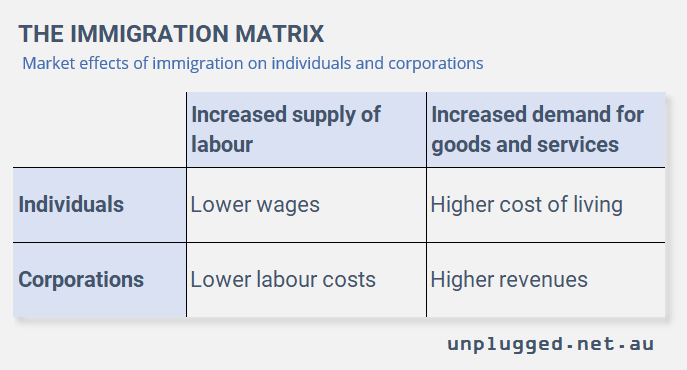
At its most fundamental level, immigration simultaneously increases the supply of labour while boosting demand for nearly everything else. The Immigration Matrix captures this dynamic between individuals and corporations, and what it reveals is clear:
Immigration transfers wealth from individuals to corporations.
Increasing the supply of labour lowers the price of labour. For individuals, this means lower wages and for corporations, it means lower labour costs.
Increasing demand for goods and services increases prices. For individuals, this means a higher cost of living and for corporations, it means increased revenues.
For individuals, lower wages and increased cost of living decreases wealth.
For corporations, higher revenues and lower labour costs increases wealth.
Increased supply of labour – Individuals
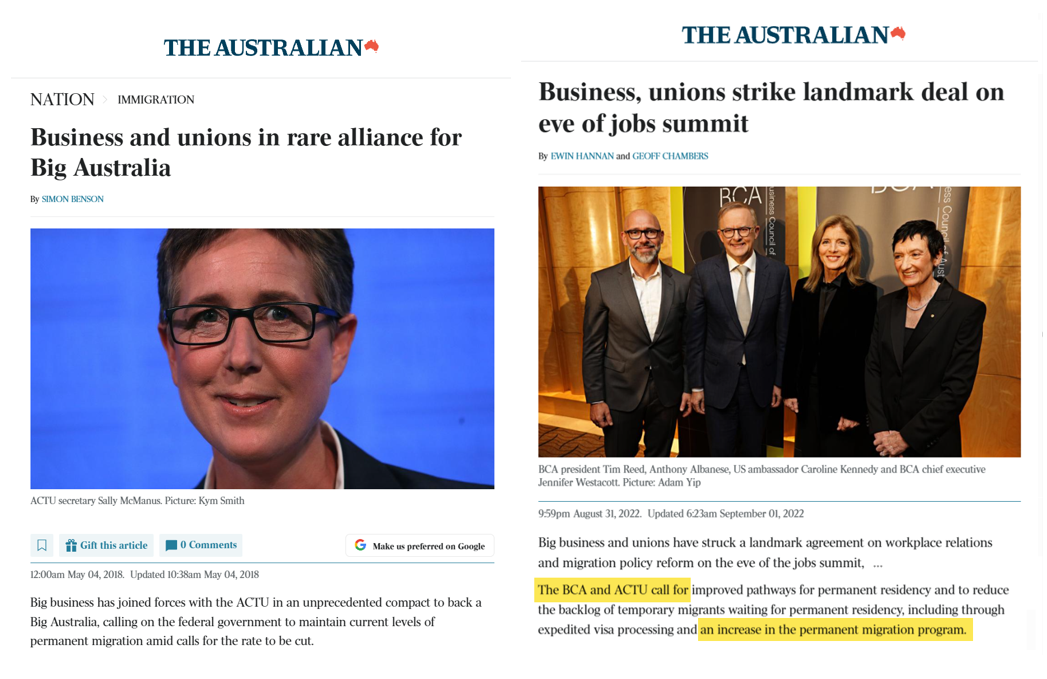
It seems paradoxical that a Labor Government would flood the Australian labour market with large numbers of low-wage workers from developing countries, placing them in direct competition with local jobseekers and driving down wages. Even more surprising is the Australian Council of Trade Unions (ACTU) forming a partnership with the Business Council of Australia (BCA) to actively support mass immigration. At a time when workers are already grappling with a cost-of-living crisis and a severe housing shortage - where many full-time employees have been priced out of the market entirely and now face the choice between share accommodation or a tent - it makes you wonder who is really running the country.
Increased supply of labour - Corporations
On average - apart from cost of goods sold - wages and salaries represent the single largest expense for most Australian corporations. Lowering the price of labour therefore delivers a direct and substantial boost to the bottom line.
The standard justification for flooding the labour market is, of course, the alleged “labour shortage.” Yet if demand for labour truly exceeded supply, wages would be rising. They are not. So, there's no labour shortage. To resolve this apparent paradox it is necessary to distinguish between demand and desire.
The most fundamental concept in economics is scarcity: limited resources and unlimited wants (or desire). Labour is a resource, and the desire for it is unlimited. But desire and demand are not the same thing.
- Desire (or wants): Pure human preferences or cravings for goods and services. They are limitless and require no money or purchasing power.
- Demand: Desire plus the willingness and ability to pay at the prevailing price. Only demand appears on the market demand curve and actually influences prices and quantities.
Example: You may desperately desire a luxury yacht, but you only demand one if you have the cash to buy it at the current price. Mere wanting does not shift the demand curve or raise the price.
Exactly the same logic applies to labour. Employers have an unlimited desire for more workers, but they only demand labour when they are willing and able to pay the going wage. After twenty-five years of mass immigration and an extra eight million people, that desire remains insatiable - yet real demand (backed by purchasing power) has not produced rising wages.
Genuine skills shortages are simply imbalances within the existing labour market and are self-correcting. If a particular skill is scarce, wages for that skill rise, attracting more people to train in it. That is how the labour market has functioned since the beginning of civilisation - until the policy of permanent large-scale immigration short-circuited the price signal.
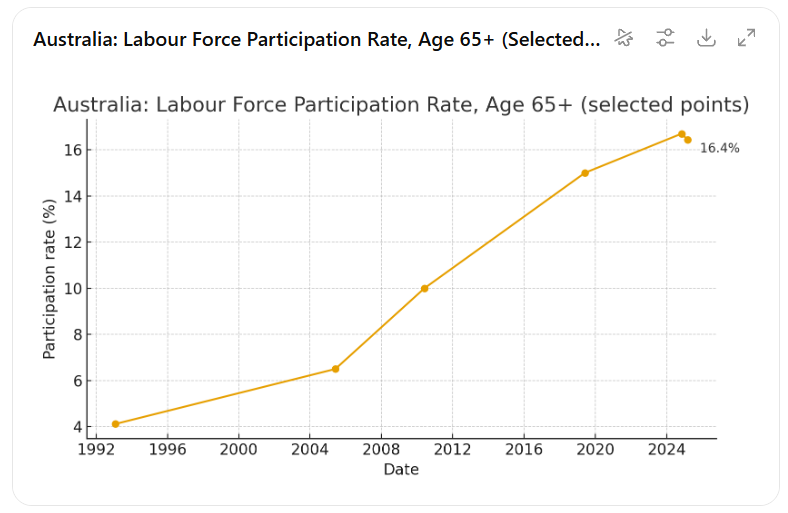
The claim that we need to import workers to offset an ageing population is largely a pretext. Australians aren’t just living longer - they’re also staying in the workforce longer, with participation among over-65s steadily rising. Even if ageing were a serious constraint, immigration would do little to change the overall picture, given the median age of the population is about 38 and the median age of permanent arrivals is around 37.
Likewise, the idea that 'we need more migrants to build homes for all the migrants coming here' is just comical - and yet it remains a common line from policymakers and vested interests.
Increased demand for goods and services - Individuals
Immigration has driven a surge in demand for goods and services across the economy, but nowhere is this more obvious - or more damaging - than in housing. The result is the housing crisis we now face: sharply higher house prices and rents caused by the sudden increase in the number of people competing for existing dwellings.
Contrary to the official narrative, this is not a supply problem. The total number of dwellings in Australia continues to rise every year, and it is logically impossible to create a housing shortage by building more houses. What has changed is the demand side: mass immigration has added hundreds of thousands of new households far faster than the housing stock can adjust, pushing prices and rents beyond the reach of many ordinary Australian workers.
Government plans to boost housing supply often assume capacity can simply be scaled up, but that overlooks existing constraints in the construction sector. At the same time, simply reducing immigration doesn't seem to have occurred to them. In an already tight housing market, the building industry is effectively at or near full capacity. Even if additional projects could be delivered, much of that labour and material would likely be diverted from other developments rather than creating a net increase in total housing supply.
Reducing tax incentives for property investors would help more Australians buy their own home, but it does nothing to change the underlying problem: the number of houses and the number of people competing for them. The total housing stock and population remain unchanged, so the overall market imbalance, the housing shortage, and record levels of homelessness are left untouched. Build-to-rent currently accounts for less than 1% of the market, making its overall impact relatively marginal.
Some organisations, such as the Australia Institute, claim that sky-rocketing house prices are caused by the Capital Gains Tax (CGT) discount rather than increased demand from immigration. Their argument, however, fails to explain why rents have also soared. If the issue were simply a tax-driven increase in investor supply, more rental properties should have pushed rents down - not up. Their favourite graph, which lines up the price surge with the introduction of the CGT discount in 1999, conveniently ignores that the rise aligns far more closely with the acceleration of mass immigration a few years later. It also omits the introduction of negative gearing in 1936, another major tax change. Most tellingly, a one-off adjustment to the tax system in 1999 should have produced a one-off effect on prices. It's hard to believe that house prices are still climbing today because of a policy tweak made twenty-seven years ago. The CGT discount has not kept growing - but the population has.

Beyond housing, supply is highly elastic for most other goods and services. Immigrants increase consumption, but they also provide the labour that expands production capacity in these industries, enabling output to rise in step with demand. Utilities, however, are a clear exception: electricity, natural gas, water and sewage services all depend on large-scale, long-lead-time infrastructure - power plants, transmission grids and treatment facilities - that cannot expand quickly enough to match rapid population growth. The added demand from more households therefore translates directly into higher rates and bills.
Immigration also drives demand for government services and infrastructure - costs that ultimately fall on taxpayers but are rarely discussed. I haven’t seen a more recent estimate, but in 2019 Infrastructure Australia put the cost of keeping pace with population growth at around $40 billion per year. Over 25 years of sustained high immigration, that would total roughly $1 trillion in infrastructure spending - about the same as current government net debt.
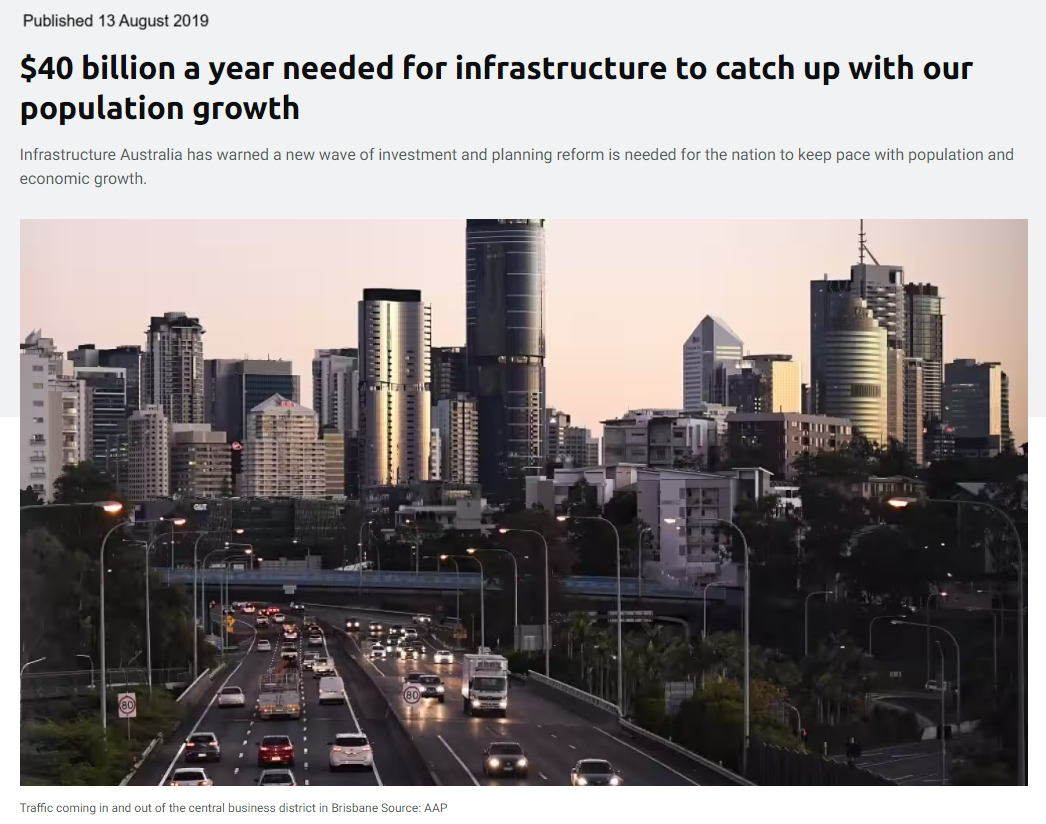
The scale of infrastructure spending may also help explain the ACTU’s pro-immigration stance, given the pipeline of projects benefits powerful unions such as the CFMEU. Notably, the CFMEU donated $1.974 million to Labor ahead of the 2022 federal election. Shortly after taking office, the Albanese government lifted the permanent migration cap from 160,000 to 195,000 places per year. They did however also scrap the federal building code and weakened the Australian Building and Construction Commission before abolishing it later that year.
Increased demand for goods and services - Corporations
It’s not just property developers who benefit from immigration - almost every corporation in the country does. The primary effect is simple: a larger population expands the market and lifts revenues. More people means higher aggregate consumption of goods, services, housing, and utilities, which drives higher sales volumes even if prices stay the same or only rise modestly in competitive sectors.
In less responsive (inelastic) sectors - like housing, construction, and utilities - the surge in demand can also push prices higher, boosting margins as well as revenue.
Take supermarkets as a basic example: if the average person spends around $100 per week, an additional 8 million people translates to roughly $42 billion a year in extra revenue, much of it flowing to Coles and Woolworths. The same dynamic applies across the economy - more people means more customers for airlines, banks, energy providers, telcos, and insurers. It’s no surprise, then, that the Business Council of Australia and other industry groups are among the most vocal advocates for continually increasing immigration. Instead of competing for a larger slice of the pie, corporations are making the whole pie bigger.
Conclusion
Another way to view this is that immigration lifts aggregate economic growth, but the gains are unevenly distributed. While total GDP - and per corporation GDP - expand, per capita GDP has been stagnating or declining, with Australia recently experiencing its longest per capita recession on record.
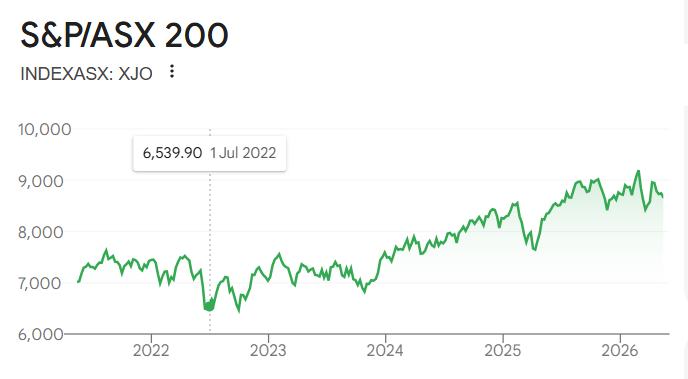
The stock market reflects this divergence. The S&P/ASX 200 has risen by around 32% since the end of the 2021–22 financial year under the Albanese government, while real wages have declined - highlighting the gap between strong corporate performance and weaker outcomes for individuals.

Not all jobs can be offshored to countries with cheap labour, so instead of offshoring the jobs, corporate Australia has been onshoring the cheap labour. As they say: import the third world - become the third world.