
Paterson's Law of Immigration and Wealth Transfer

Immigration is often debated in terms of culture, demographics, or economic growth. Yet beneath these complex discussions lies a simple economic mechanism: immigration simultaneously increases the supply of labour and the demand for goods and services.
This observation can be expressed as Paterson’s Law of Immigration and Wealth Transfer:
Immigration tends to transfer wealth from labour to capital by simultaneously increasing the supply of labour and the demand for goods and services, thereby suppressing wages and raising living costs for wage earners while reducing labour costs and increasing revenues for owners of capital.
The first effect is on the labour market. An increase in the supply of workers places downward pressure on wages, particularly in occupations where labour is easily substitutable. For businesses, however, the same process reduces labour costs and can increase profitability.
The second effect is on demand. New residents require housing, transport, healthcare, education, food, and countless other goods and services. While this expands markets and increases business revenues, it can also place upward pressure on prices - especially where supply is inelastic, such as housing and infrastructure.
The result is a four-part economic dynamic:
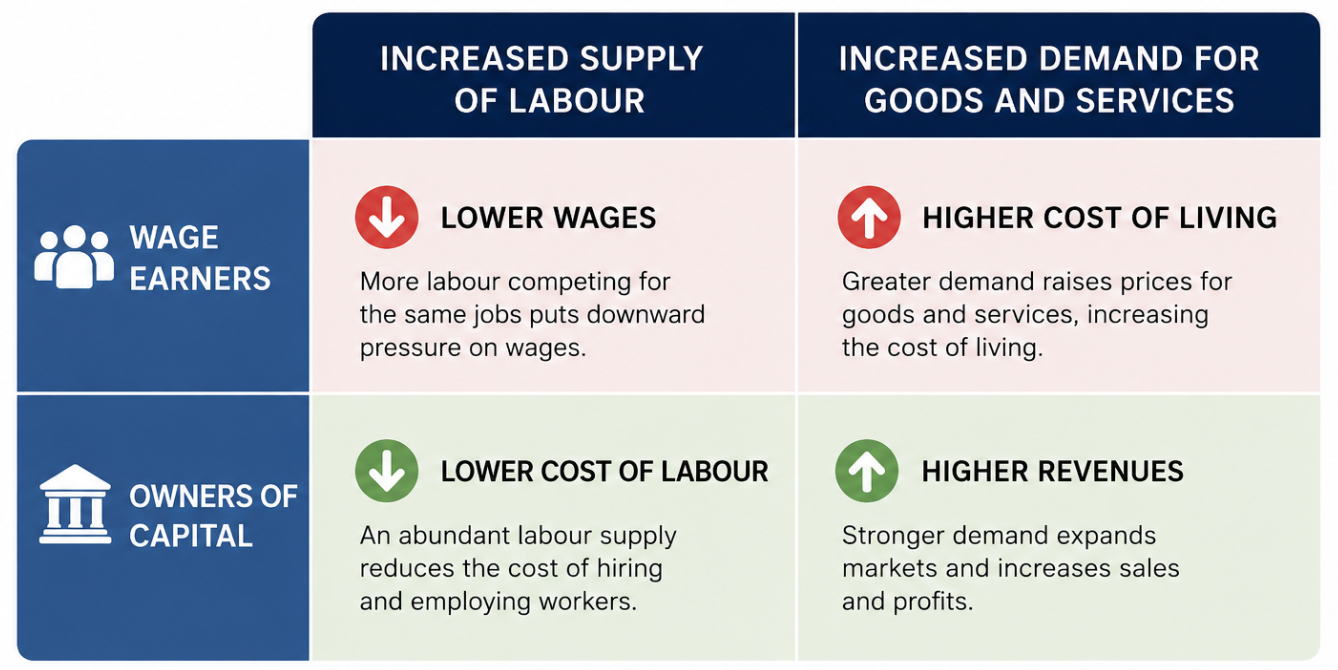
Viewed through this framework, immigration does not affect all groups equally. Wage earners may face both downward pressure on incomes and upward pressure on living costs. Owners of capital, by contrast, can benefit from lower input costs and larger consumer markets.
This does not imply that immigration is inherently good or bad. Rather, it suggests that the gains and costs of immigration are distributed unevenly. Aggregate GDP may rise while individual living standards stagnate or decline.
Paterson’s Law therefore provides a simple lens through which to analyse immigration policy: not merely by asking whether immigration increases economic output, but by asking who receives the benefits and who bears the costs.